Behind the Scenes
A high tea among the alpacas is a special experience. Taking them out to get a breath of fresh sea air can certainly be called exciting. But what do the animals do between events? What goes on around the farm yard? What challenges do the caretakers face? A series on daily occurrences and questions.
Jacoline Vlaander
04. Attack
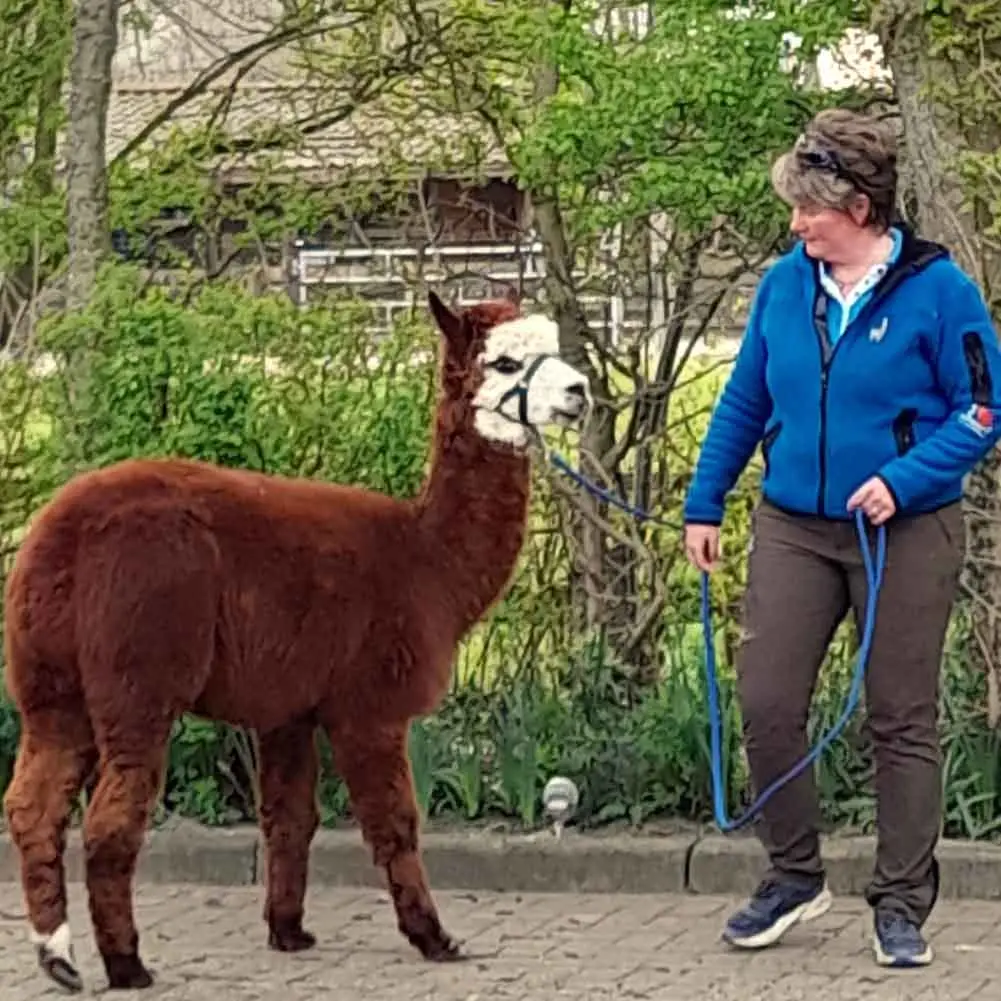
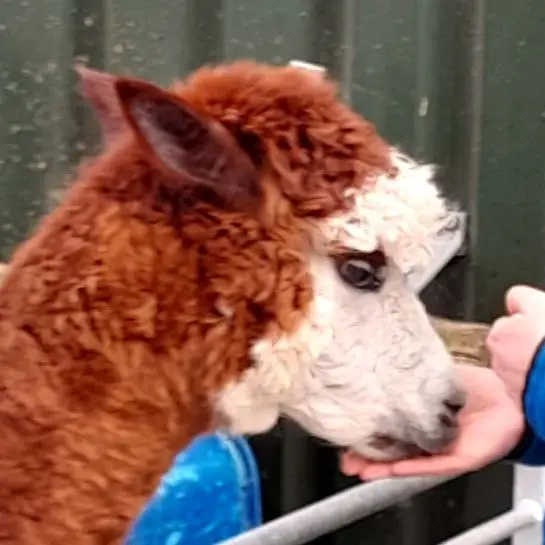
Despite ongoing training, a consistent approach, and the team’s endless patience, Jona continues to catch everyone off guard. Outbursts happen without warning: growling, jumping, snapping, and biting. He focuses this behavior primarily on humans, though not on everyone equally. “Why he does it remains a mystery,” Mara explains. “Of course, we know that your own emotions—even subconscious ones—can amplify whatever a animal is feeling. Fear breeds fear. Aggression breeds aggression. It’s a mutual loop. For alpacas with Berserk Male Syndrome (BMS), that response is heightened even further. With Jona, he can blow a fuse even when you are completely relaxed and cheerful.”
When he suffers a setback, Mara remains steady: “Never reward undesirable behavior—neither by trying to soothe nor by reacting with anger. So I don’t respond. I plant both feet firmly on the ground and breathe deeply. With most animals, you feel the tension drain away. Jona, however, finds it perplexing when he gets zero reaction. He stops jumping, looks utterly bewildered, but he still remains far from relaxed.”
A tense internship day
On a sunny afternoon in March, a student from a special education school arrives for a short work placement: “He was tall and lanky, quietly tagging along as we cared for the animals and scooped manure in the pasture. Perhaps he found it exhausting, because he kept sitting down. We repeatedly told him not to do that; sitting down makes you vulnerable around animals, especially when some of the alpacas present aren’t yet fully familiar to us.”
Before long, he dropped down onto the grass once more. Right at that moment, Jona strolled past and turned toward him. Startled, the boy scrambled to his feet and sprinted away: “Never, ever do that. You can’t outrun a healthy alpaca. Jona bolted right after him—jumping, screaming, growling, and snapping.”
Taking the brunt of it
All that commotion builds up internal tension, and that tension needs an outlet. That evening in the barn, Mara takes the brunt of it. After feeding, Jona approaches her: “He wanted to sniff my face, but he was being pushy. I didn’t allow it and kept him at arm’s length. He refused to accept that boundary. A haze came over his eyes—almost blind rage. In those moments, he becomes a completely different animal, and I can no longer reach him.”
Jona leaps on top of her, biting her head, shoulders, and arms. Mara’s face slams hard against the wooden wall: “Right then I thought: stay on your feet, because if I fall, it’s over. He’d jump on me—big and heavy as he is—and could easily break my back. I stood my ground, breathing deeply, wrapped my arms around his neck, and pulled him tight against me to restrict his movement.” She calls out to Zayid, who immediately bounds out of the paddock, with Winston right on his heels: “Screaming, they bit into Jona’s legs, spat on him, and jumped on him. The struggle turned into one massive, green-spit-flying, screeching commotion.”
Once again, Jona’s social clumsiness with his own species becomes glaringly obvious. The herd’s corrections leave him confused: “His aggression didn’t transfer to them; he was mostly just distracted. Fortunately, they successfully snapped him out of that haze. After a while, I felt him relax, and I let him go. He accepted the pause, walked outside, and Zayid and Winston let him pass.”
Two sides to every story
Mara originally wanted to end the confrontation differently, as she typically does after power struggles with other alpacas: “With relaxation exercises in the barn—standing quietly beside Jona until he eventually yawns, smacks his lips, and relieves himself. That diffuses the situation completely: you enforce a clear boundary, correct the behavior, and make peace with each other. But after this attack, I simply couldn’t bring myself to do it. The whole ordeal lasted about 45 minutes. My legs were shaking. I thanked Zayid and Winston, and stumbled out of the barn.”
She is fully aware that Jona’s story has two distinct sides: his positive progress and his unpredictable nature: “We have to pay close attention to what happens during the day. It seems like he reacts strongly to people with autism. Other animals would walk away, but he actively seeks out contact, even when it becomes overwhelming for him. His early imprinting is flawed, so we have temporarily canceled all arrangements with the special education school.”
Over the coming months, Mara plans to train intensely with Jona alongside Winston and Zayid: “He isn’t targeting me specifically, and I don’t hold it against him. He was reaching out in his own way, even if it wasn’t the right way. I can feel his helplessness—the fact that he lacks alternative coping mechanisms. Hopefully, we can still teach him.”
Next episode:
About a day when absolutely everything goes wrong.
Alpacas Zeelandia team
Alpacas Zeelandia team