Behind the Scenes
A high tea among the alpacas is a special experience. Taking them out to get a breath of fresh sea air can certainly be called exciting. But what do the animals do between events? What goes on around the farm yard? What challenges do the caretakers face? A series on daily occurrences and questions.
Jacoline Vlaander
11. Camillio
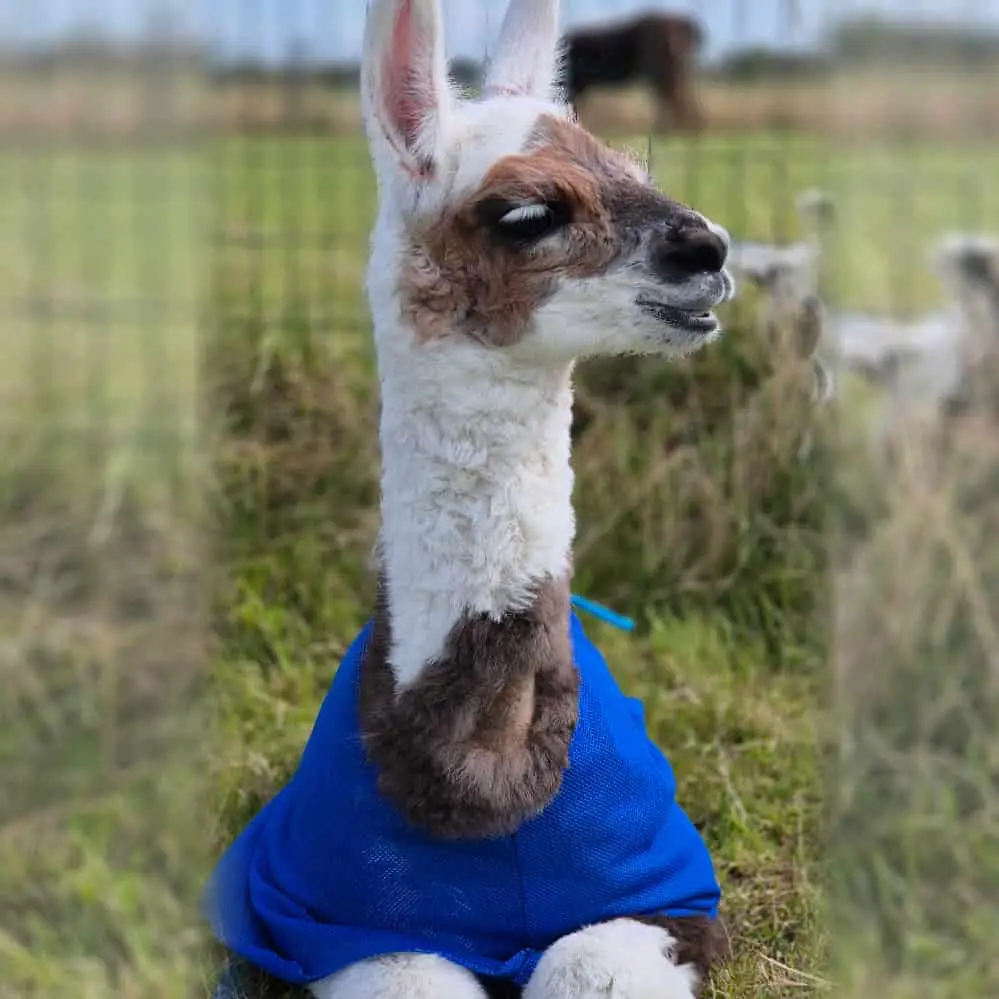
High summer. Dust clouds and yellow grass. Toxic Tansy Ragwort blooms along the verges while blue sunshades line the pastures. At the end of every day, cooling shower sessions are held for the warm animals. Beside all the daily chores and care given to the rescue alpacas, worries surrounding Camillio—Calinda’s llama cria—continue to grow: “No matter how well he ate, drank, grew, and despite how cheerful and adventurous he was, he kept collapsing on his right hind leg,” Mara explains. “He was dragging it behind him. After a few steps he would pull it forward to catch up, but doing so became increasingly difficult.”
In early August, the llamas head to the sea for an afternoon. For Camillio, it is his first time—and though no one knows it yet, it will also be his last. The excursion makes it glaringly obvious how poor his condition has become: “While negotiating the basalt stones leading down to the beach, his right hind foot folded backward. He didn’t seem to feel much, continuing to walk on the top side of his foot. Once at the tide line, he simply lay down.” It stands in stark contrast to Lorenzo, Lilly’s llama cria just two weeks older, who charges into the waves, swims back and forth, leaps out, and romps across beachgoers’ towels: “Camillio barely moved—he just watched. I had to carry him all the way back to the trailer.”
Neurological deficits
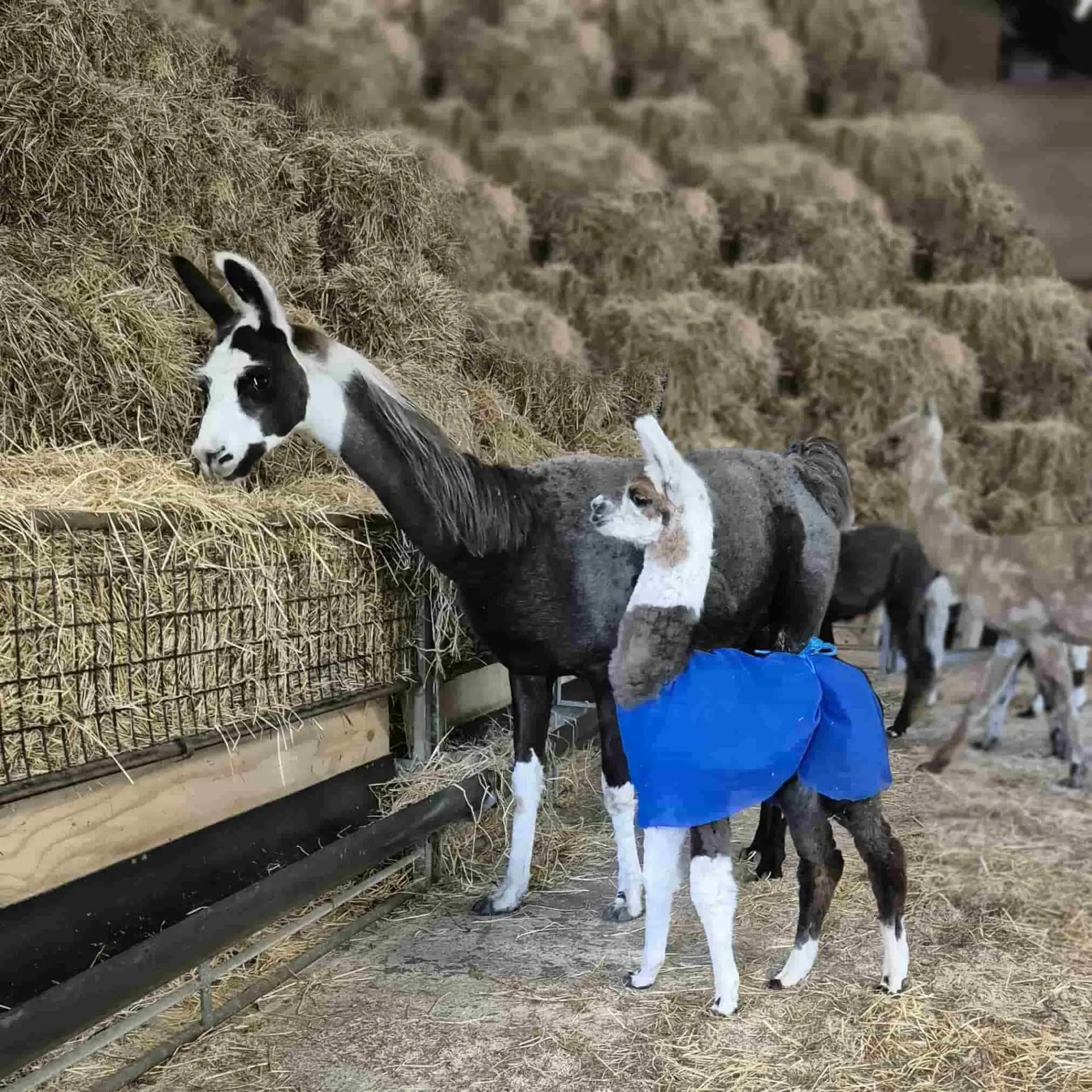
His neurological deficits intensify. At times, Camillio walks solely on his front legs in an attempt to move past the other two. Furthermore, he develops an internal infection, his firm pellets now sliding out enveloped in a layer of pus. That means additional wash sessions to keep flies and maggots at bay, alongside another course of antibiotics and pain medication.
“While nursing from Calinda, we saw how changing teats caused him to arch his back, circle around his right hind leg, and fall,” Mara says. “Calinda leaned over him humming, nudging him so he would scramble back up. But his leg wouldn’t cooperate; he stepped on it and tripped right over it.”
Four weeks
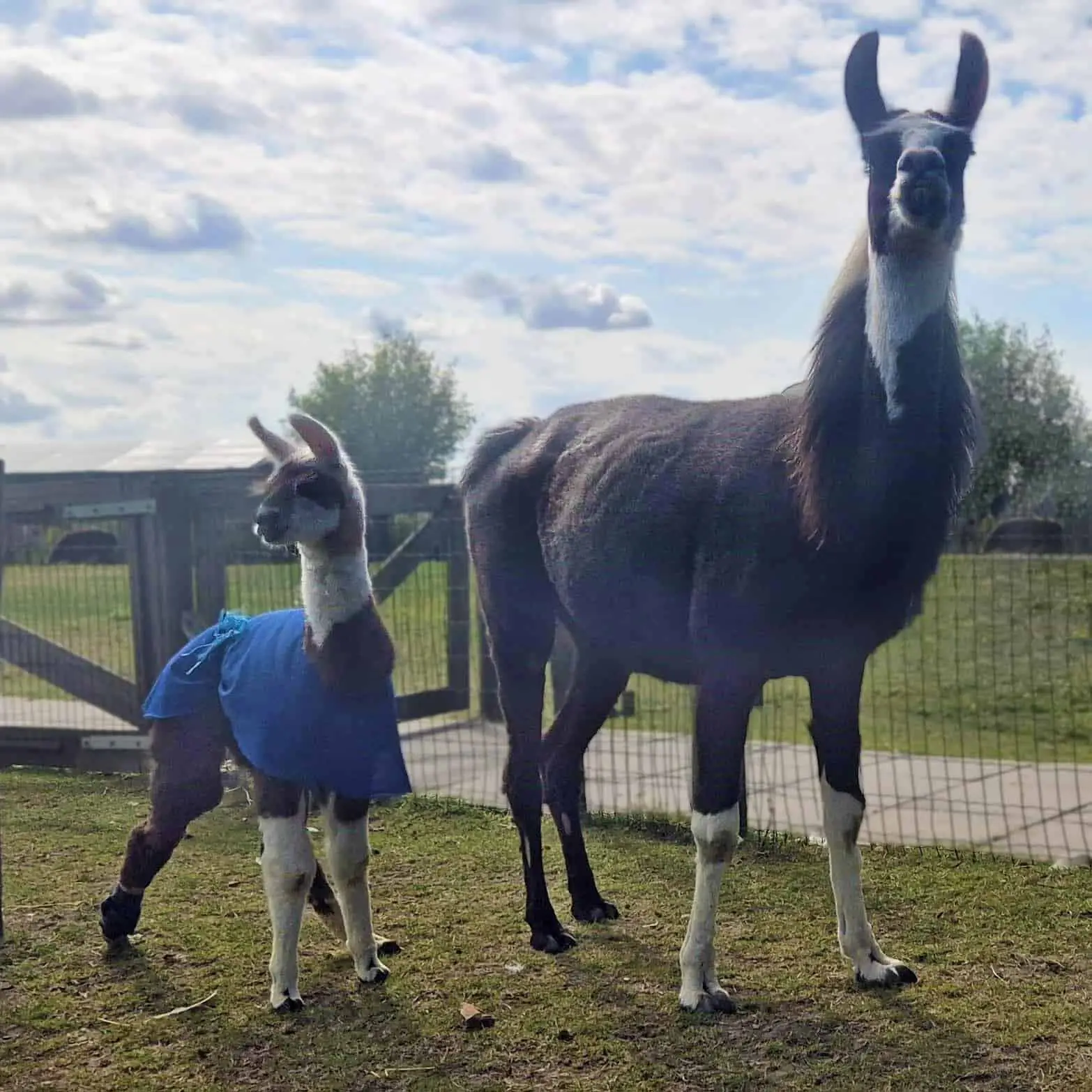
Will he grow out of it, everyone wonders. Can he find a balance? What options remain, and when must we intervene? The situation dominates the team’s daily life: “He still had the spirit for it himself,” Mara shares. “There were days he hopped through the pasture on his splinted foot as best he could—sniffing and nibbling everywhere, dipping his nose into the pond. But there were also days when he did nothing but lie in the shade.”
Ultimately, Camillio’s life spans just four weeks. The day before he is scheduled to return to Ghent University’s Faculty of Veterinary Medicine with his mother and sister—where specialists plan to evaluate whether he can manage on three legs despite his spina bifida—the next complication strikes. During his morning wash, a section of his rectal wall prolapses outward. Clean, disinfect—yet gently pushing it back has little effect; after three steps, it prolapses again. When he falls, the exposed tissue sustains further damage.
Mara and Jacco consult Belgian veterinarian Dr. Thijs Flahou, specialist in alpacas and llamas: “If it were just a matter of amputation, he would know what to do. But now there was no longer any chance of recovery. Is there any quality of life left?”
Evening ritual
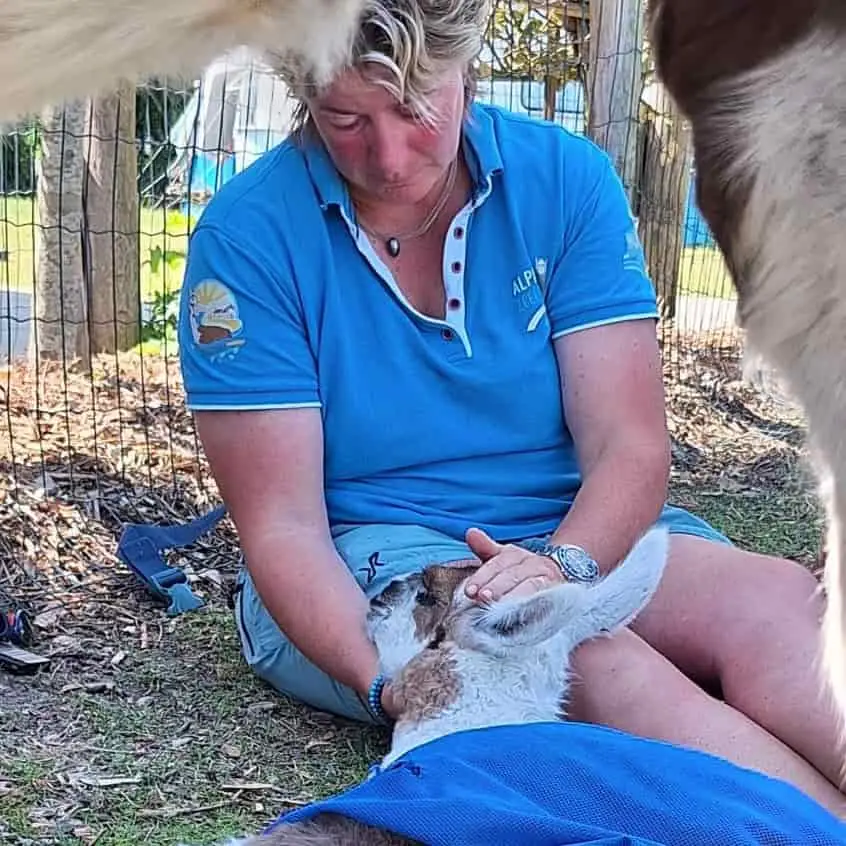
Mara treasure every memory: how Camillio would lie in the fresh flax bedding in the barn at night, his front legs tucked neatly under his chest. She would sit right across from him—very close, without touching him: “During the day, we handled him so much. Now, nothing was required. Just looking at each other.” Surrounded by peaceful quiet as the other animals sleepily pulled hay from racks and settled down to chew the cud: “He gently nibbled on my hair, sniffed my nose. Ever since his teeth came through, he had been practicing biting. His eyelashes tickled against my face.”
She would hold out two different alpaca treats between the thumb and index finger of each hand. Every evening, he got to choose. Unhurried, he would take one from between her fingers: “He had such a funny way of tasting. His little lips moved around the treat as he smacked, chewed, and swallowed.” His large eyes fixed squarely on her. “Meanwhile, I would grab a new treat so there was a choice again. We kept that up for a while.”
It gave a relaxing structure to the end of the day: “A sense of routine for him, and for me. And I could so easily imagine that if he grew up into a strong 200-kilo Camillio, it would still be our evening ritual.”
Next episode:
Animals grieve too.
Alpacas Zeelandia team
Alpacas Zeelandia team