Behind the Scenes
A high tea among the alpacas is a special experience. Taking them out to get a breath of fresh sea air can certainly be called exciting. But what do the animals do between events? What goes on around the farm yard? What challenges do the caretakers face? A series on daily occurrences and questions.
Jacoline Vlaander
10. Home
On a sunny Monday morning in mid-July, Mara drives off the yard at 06:00 AM, arriving at Ghent University’s Faculty of Veterinary Medicine before rush-hour traffic builds up. She hopes that after several days of admission, all three llamas will finally be allowed to return home today: “The students put together a walking schedule and take them on regular strolls. But for their muscles, joints, and digestion, it’s far better if they can run freely through the pastures.”
Not to mention escaping the constant stress of a foreign medical environment—stress Mara is experiencing herself: “The season is finally picking up. Guests in the accommodations and on the campsite, endless beach walks, high teas, picnics, and Meet & Feeds, last-minute bookings, and a steady stream of visitors. The days are long and intense, and driving back and forth to Ghent constantly isn’t sustainable.”
Rectal examination
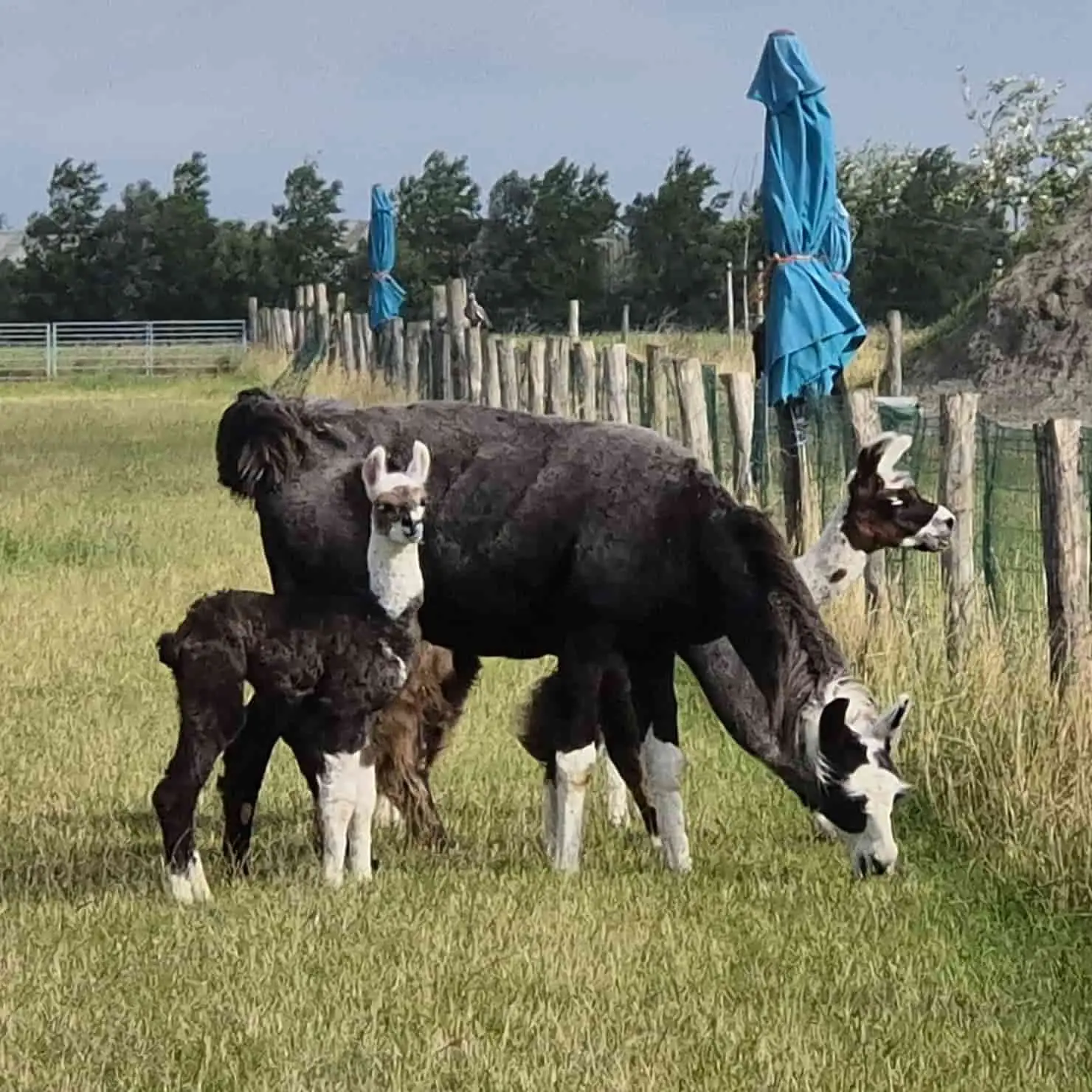
In their stall, positioned among the stables of sick and recovering horses kicking rhythmically against steel partitions, mother Calinda and big sister Cavada look up joyfully as Mara slides the gate open and steps inside. The cria—who will answer to the name Camillio—lies dozing peacefully in the hay, yawning.
Calinda and Cavada eagerly dig into the alpine muesli. Afterward, it’s time to wait for the attending vet’s morning rounds. Accompanied by three note-taking students, the vet performs a rectal exam on Camillio, who groans softly. The test checks if the surgery succeeded and whether the passage to the intestines is functioning properly—which it is! The medical team notes they would prefer to keep him a little longer until he defecates, as that provides absolute certainty everything works.
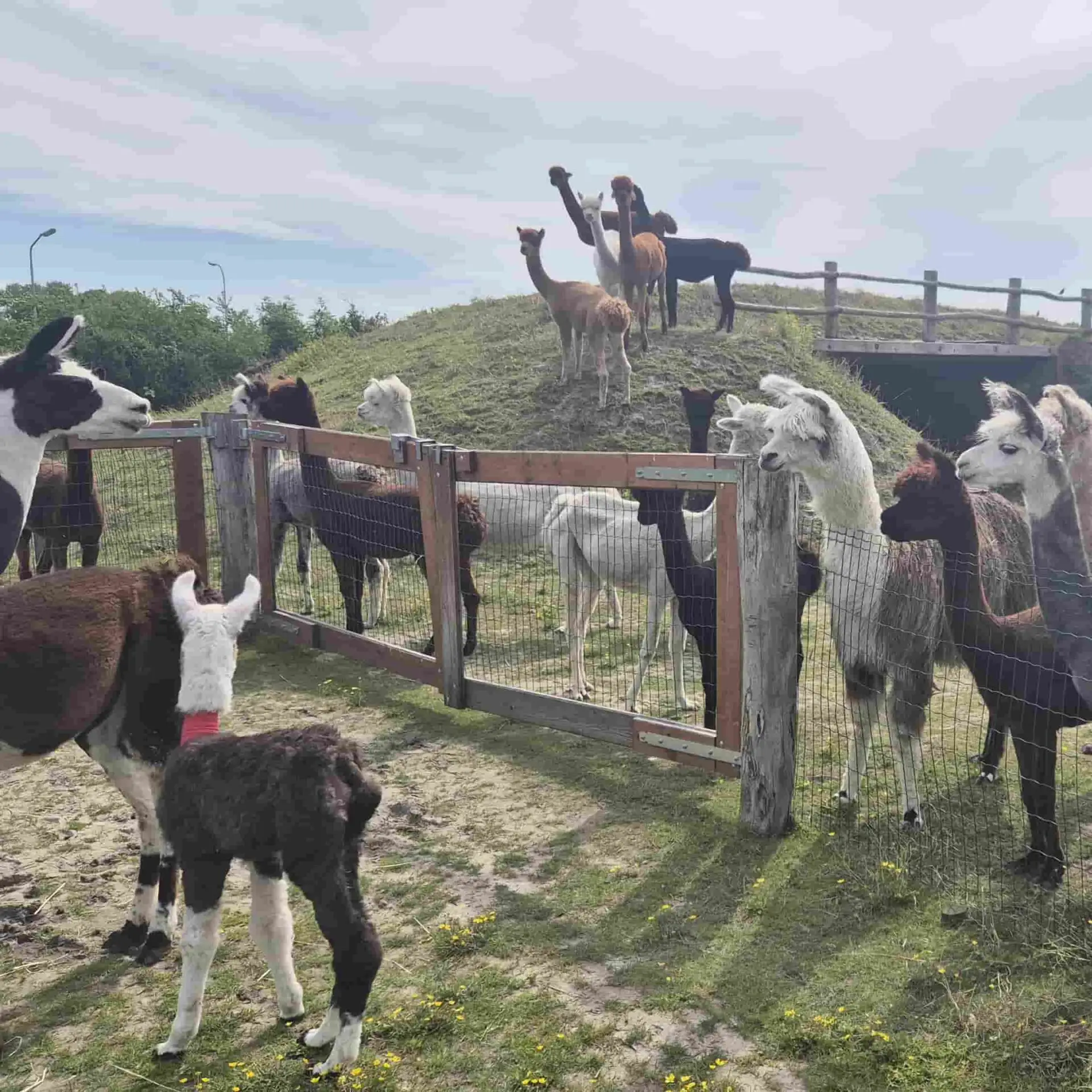
However, nobody can sit beside him for hours on end, and liquid cria droppings are easily overlooked in deep straw bedding. Mara explains that back at the farm, staff, volunteers, and interns will keep a watchful eye, while she plans to spend the evening in the barn herself. It is genuinely better for the animals to head home now. Camillio receives his final two-day doses of antibiotics and pain medication via his neck IV and—adorned with a red bandage “tie”—is cleared to return home with his mother and sister.
Spina bifida
Camillio will likely face no complications from the fact that his testicles will never descend, and he will go through life without visible external sex organs. For now, functional excretory openings are the top priority: “However, we have to keep a close eye on his spina bifida,” Mara notes. “In animals, this neurological condition typically occurs near the tail region where the vertebrae and skin haven’t fully developed. You can see it in the bump on his lower back, where the spinal nerves protrude slightly with barely any protection from a thin layer of skin and soft curls.”
Thus, worries remain. Other young animals must be prevented from jumping on top of Camillio during rough play, and he continues to experience coordination issues. His hind legs occasionally sway weakly; when running, he crosses them and bounds somewhat like a kangaroo. He also collapses heavily when lying down: “Perhaps his back hurts,” Mara reflects. “Some days are better than others. Still, he thoroughly enjoys the peace, space, relaxation, and company of his herd mates. His bowel movements started up quickly once back home. Because he lacks sphincter control, when nature calls, he has to go immediately—releasing urine and droppings on the spot without raising his tail or squatting.”
Summer flies
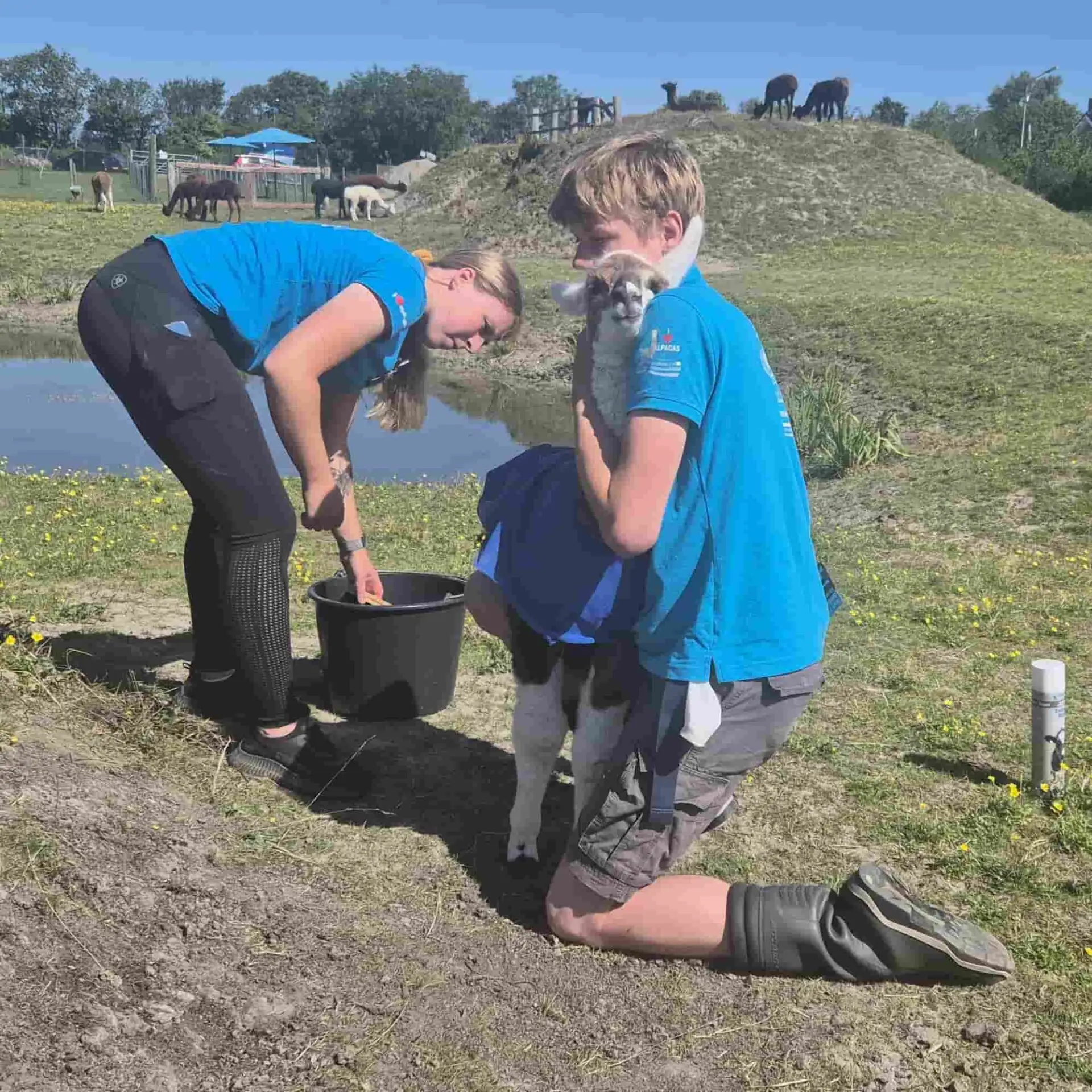
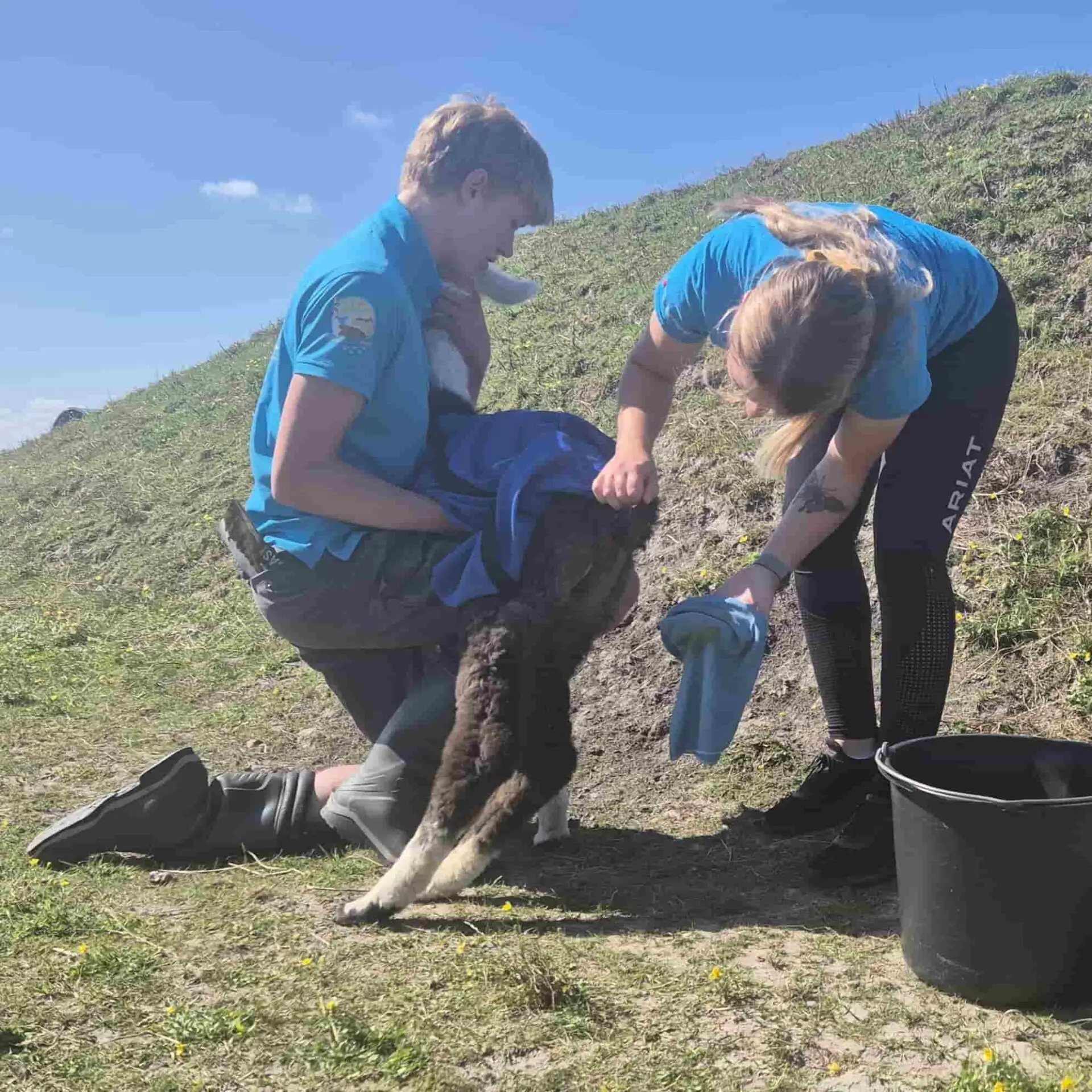
This condition creates substantial extra work for all staff, volunteers, and interns—especially during warm summer days with abundant flies. Multiple times a day, the routine remains: wash Camillio’s rear end, gently brush away dried droppings, scrub his tail, backside, and inner legs clean, disinfect, dry him off, and spray him with Veerust (fly repellent). He also wears a fly sheet to prevent swarming insects from crawling into his anus.
On days when he feels weak, he endures the process placidly. On days when he feels energetic, he bolts and tries to wriggle out of their hold: “He is already getting big and strong,” Mara laughs. “Since returning from Ghent, he has gained over 7 kilos. We always perform the treatments in pairs. Now that his teeth are coming through and he’s eating solid food, it is fortunately becoming a bit less intensive. Nothing beats nice, firm pellets!”
Next episode:
Growing concerns surrounding Camillio keep the team occupied throughout the summer.
Alpacas Zeelandia team
Alpacas Zeelandia team